
A back bedroom that never cools down, a garage office that feels sticky by noon, or an aging AC system that keeps needing repairs can change the replacement conversation quickly. When comparing ductless versus central air conditioning, the right answer depends on more than square footage. Your home’s layout, existing ductwork, humidity needs, budget, and how you use each room all matter.
For Treasure Coast homeowners, dependable cooling is not optional. South Florida heat and humidity put every system to work for much of the year. The best choice is the one that delivers even comfort, manages moisture effectively, and can be serviced properly for the long term.
Ductless Versus Central AC: The Basic Difference
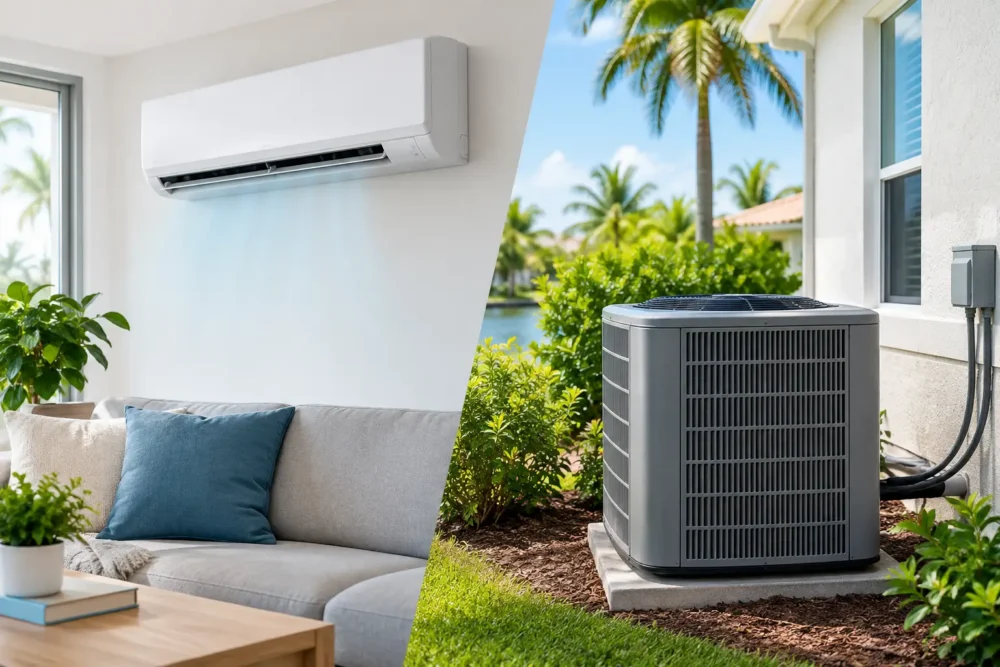
A central air-conditioning system cools the home through a network of ducts. An outdoor unit works with an indoor air handler, and conditioned air travels through supply vents in each room. Most homes in our area were built with central AC in mind, making replacement a straightforward option when the ductwork is in good condition.
A ductless system, often called a mini-split, uses one outdoor unit connected to one or more indoor wall-mounted, ceiling-mounted, or concealed air handlers. Each indoor unit serves a specific room or zone. There are no large ducts carrying air throughout the home.
Neither option is automatically better. Central AC is often the practical fit for a whole-house replacement. Ductless equipment can be an excellent solution for additions, converted garages, sunrooms, guest suites, and rooms that central air cannot cool evenly.
When Central AC Makes More Sense
Central air is usually the strongest choice for homeowners replacing an existing whole-home system with usable ductwork. It provides a familiar, consistent approach to cooling every bedroom, living space, and hallway from one integrated system.
A properly sized central system can distribute air evenly throughout the home, especially when duct design, insulation, return-air pathways, and airflow are evaluated during installation. Newer systems may also offer variable-speed operation, which can run at lower output for longer periods. That longer run time can improve comfort and help remove moisture from indoor air.
Central AC also keeps the equipment less visible inside the home. Instead of having an air handler in each zone, you have vents and a thermostat. For homeowners who prefer a clean, uniform look across the house, that can be a meaningful advantage.
There are trade-offs. Ductwork must be sound, properly sealed, and sized for the equipment. Leaky or poorly insulated ducts in an attic can waste cooled air and raise utility costs. If your home has older ducts, damaged flex duct, poor airflow to certain rooms, or signs of dust buildup, those concerns should be addressed as part of a replacement plan rather than ignored.
Central systems can also be a better fit for homes where occupants want one thermostat setting and simple operation. A family that uses most rooms every day may not benefit much from separate zone controls.
Central AC is often a good fit when:
You already have functional ducts, need to cool the entire home, prefer a single integrated system, and want a replacement that follows the home’s existing design. It is also a practical choice for many rental properties and commercial spaces where straightforward controls and broad coverage matter.
When a Ductless System Is the Better Choice
Ductless mini-splits shine when extending ductwork would be difficult, expensive, or disruptive. A Florida room, enclosed porch, detached workshop, room addition, converted garage, or guest area can often be cooled efficiently with a dedicated ductless unit.
Because each indoor air handler has its own control, ductless systems offer true zoning. You can keep a home office comfortable during the day without cooling unused bedrooms to the same setting. Seasonal residents may appreciate the ability to condition only the spaces they are using while still protecting the property from excessive heat and humidity.
Ductless equipment is also helpful when one room is consistently warmer than the rest of the home. Before adding a mini-split, however, it is worth identifying why the room has a problem. The issue could be undersized ductwork, a blocked return, poor attic insulation, sun exposure, or an aging central system. A ductless unit may solve the comfort issue, but correcting the underlying cause can sometimes be the smarter investment.
Installation is generally less invasive than adding new duct runs. The indoor and outdoor components are connected through a small opening in the wall, rather than a large duct chase. That can make ductless equipment especially attractive in homes with limited attic access or in areas where preserving finished walls and ceilings is important.
The compromise is visibility. Wall-mounted units are designed to be compact and quiet, but they are still part of the room. Homeowners should also remember that every indoor head needs regular filter cleaning and professional maintenance. A multi-zone ductless system has several components, so service planning matters.
Humidity Control Matters as Much as Cooling
In Stuart, Port St. Lucie, Jensen Beach, and across the Treasure Coast, a home can feel uncomfortable even when the thermostat says the temperature is low enough. That is usually a humidity issue.
Both central and ductless systems can remove moisture as they cool, but performance depends on correct sizing, run time, equipment settings, and installation quality. An oversized AC system may cool the home too quickly and shut off before removing enough humidity. A system that is too small may run constantly and still struggle on the hottest afternoons.
This is why replacement decisions should not be based on the size of the old unit alone. A professional load calculation considers the home’s square footage, windows, insulation, orientation, occupancy, and other factors that affect cooling demand. It helps prevent the common mistake of installing more capacity than the home actually needs.
For homes with persistent moisture concerns, an HVAC professional may recommend adjustments to airflow, ductwork, thermostat settings, ventilation, or indoor air-quality equipment. The goal is not simply colder air. It is a home that feels dry, comfortable, and healthy.
Comparing Cost, Efficiency, and Long-Term Value
Upfront cost varies widely based on the system type, efficiency rating, number of zones, electrical requirements, duct condition, and installation complexity. A single-zone ductless system for one addition may cost less than extending central ductwork. A whole-home multi-zone ductless installation, however, can cost more than replacing an existing central system with sound ducts.
Energy efficiency also depends on how the system is used. Ductless zoning can reduce waste when only certain rooms need cooling. Central systems can be highly efficient when they are properly sized, installed, and paired with sealed, insulated ducts. Neither label guarantees lower bills by itself.
Think beyond the purchase price. Consider expected maintenance, repair access, filter care, warranty coverage, humidity performance, and whether the system will make the property more comfortable for the people who use it every day. Financing may also make it easier to choose dependable equipment rather than delaying a replacement until a complete breakdown forces a rushed decision.
Can You Use Ductless and Central AC Together?
Yes. Many homes benefit from a hybrid approach. The central system can handle the main living areas and bedrooms, while a ductless unit serves a problem room, addition, or space used at different hours than the rest of the home.
This approach can be especially useful for a garage conversion, upstairs room, pool cabana, home office, or guest suite. It avoids putting extra strain on the central system or attempting a duct extension that may not deliver enough airflow. The key is making sure both systems are sized and installed with the whole property in mind.
Choose Based on Your Home, Not a One-Size-Fits-All Answer
The best way to decide is to start with an on-site evaluation. A qualified technician can inspect your existing equipment and ducts, ask how each room is used, identify comfort concerns, and explain whether central replacement, ductless zoning, or a combination makes the most sense.
If your AC is unreliable, a room never feels comfortable, or you are planning an addition, do not wait for the hottest day of the season to make the call. Treasure Coast Air Conditioning can help you evaluate practical options and move toward a cooling solution that keeps your household comfortable when Florida weather is at its toughest.