
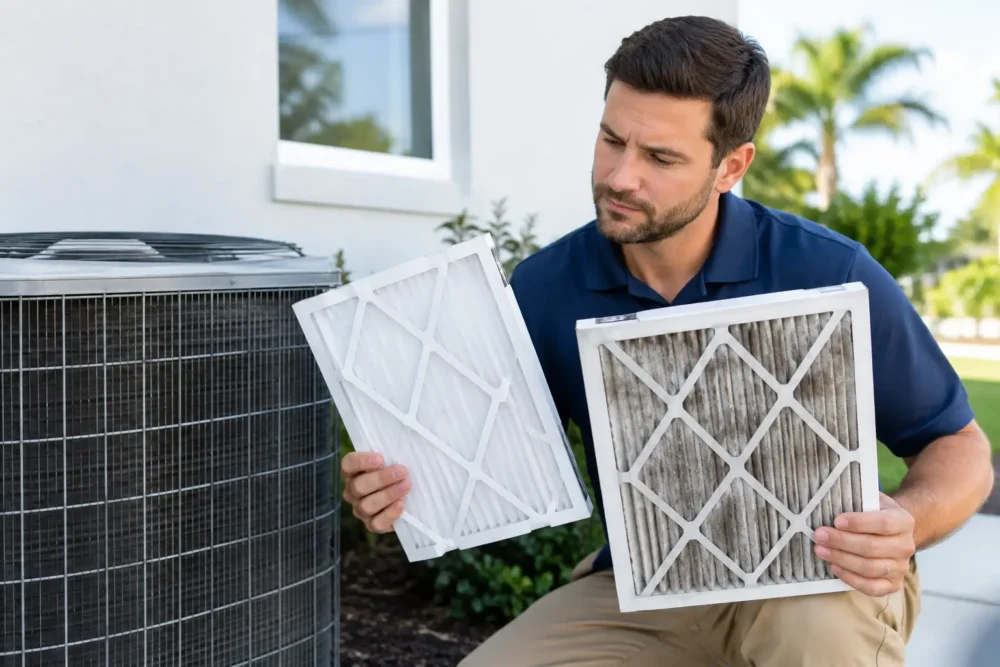
A filter that is too weak can leave dust circulating through your home. A filter that is too restrictive can make your AC work harder during the hottest week of a Treasure Coast summer. Knowing how to choose AC filters is not about buying the highest-rated option on the shelf. It is about finding the right fit for your system, your household, and the air quality concerns you actually have.
In South Florida, your air conditioner runs hard for much of the year. A clean, properly selected filter helps protect the equipment, supports steady airflow, and makes your indoor space more comfortable. The wrong filter, or a filter left in place too long, can contribute to frozen coils, reduced cooling, higher energy use, and unnecessary repair calls.
Start With the Correct Filter Size
Before comparing filtration ratings, check the size printed on the edge of the filter currently installed in your return grille or air handler. Common residential sizes include 16 x 20, 20 x 20, and 20 x 25, but every system is different. Never guess based on the opening alone.
You may see both a nominal size and an actual size. A filter labeled 20 x 20 x 1, for example, may physically measure slightly smaller so it can slide into its track. Match the labeled size your system requires unless a qualified HVAC technician tells you otherwise.
Thickness matters just as much as length and width. Many systems use 1-inch filters, while others are designed for 2-inch, 4-inch, or 5-inch media filters. A thicker filter generally has more surface area and can often capture more particles with less airflow resistance. But it must fit the cabinet correctly. Forcing a filter into place, bending it, or leaving gaps around the edges defeats its purpose.
How to Choose AC Filters by MERV Rating
MERV stands for Minimum Efficiency Reporting Value. In simple terms, the higher the MERV number, the smaller the airborne particles the filter can capture. That does not automatically mean a higher number is the best choice for every home.
For many Florida households, a pleated filter in the MERV 8 to MERV 11 range is a practical starting point. It captures a meaningful amount of dust, pollen, lint, mold spores, and pet dander while allowing reasonable airflow in many residential systems.
A MERV 13 filter captures finer particles and may be a good choice for households with significant allergy concerns, respiratory sensitivities, or high indoor air-quality needs. However, it can also create more resistance to airflow, especially in an older system, a system with undersized return ductwork, or a unit designed around a basic 1-inch filter.
If your AC has weak airflow, rooms that cool unevenly, a history of frozen evaporator coils, or an older blower motor, do not move to a high-MERV filter without professional guidance. Better filtration should not come at the expense of the airflow your equipment needs to cool and dehumidify your home.
A practical MERV guide
- MERV 4 to 6: Basic protection from larger dust and lint particles. Often used in lightly occupied spaces, but usually limited for a busy household.
- MERV 8: A dependable everyday choice for many homes. It can help with household dust, pollen, and pet dander.
- MERV 11: A stronger option for families with pets, frequent dust buildup, or mild allergy concerns, provided the system can handle it.
- MERV 13: Higher-level particle capture for specific indoor air-quality needs. Ask an HVAC professional to confirm compatibility before using it.
Filters marketed as HEPA filters should be approached carefully. True HEPA filtration is highly effective, but most standard residential central AC systems are not designed to pull air through a true HEPA filter without specialized equipment. Installing one in a typical filter slot can severely restrict airflow.
Choose the Filter Type That Fits Your Household
Not all filters are built the same. Flat fiberglass filters are inexpensive and allow easy airflow, but they primarily protect the HVAC equipment from larger debris. They do little to improve the air your family breathes.
Pleated filters are the most common choice for homes because they offer better particle capture without requiring a major change to the system. Their folded material creates more surface area than a flat filter. For most homeowners, a quality pleated filter with an appropriate MERV rating offers the best balance of cost, filtration, and airflow.
Washable or reusable filters can seem economical, but they require careful cleaning and complete drying before reinstallation. A damp filter can encourage mold growth, which is especially concerning in Florida’s humid climate. Reusable filters also often provide less filtration than a properly selected disposable pleated filter.
Electrostatic filters use static charge to attract particles. Some are disposable, while others are washable. Performance varies widely by product, so focus on the stated MERV rating and whether the filter is compatible with your system rather than relying on the word electrostatic alone.
Factor in Pets, Allergies, and Florida Humidity
Your household should guide the decision. A home with two shedding dogs, a cat, and children coming in from the beach will load a filter faster than a lightly occupied condo. A vacation property may have a different challenge: long periods with little activity, followed by heavy AC use when the owners return.
If someone in the home has allergies or asthma, filtration can help reduce airborne irritants, but a filter is only one part of the solution. Duct condition, humidity control, cleaning habits, ventilation, and possible air purification equipment all affect indoor air quality.
Humidity deserves special attention on the Treasure Coast. Your air conditioner removes moisture as it cools, but restricted airflow can interfere with that process. A filter that is overly dense or overdue for replacement can reduce system performance and leave the home feeling cool but clammy. That is a sign to check the filter first, then schedule service if the problem continues.
Replace Filters Before They Become a Problem
The standard advice to replace a filter every 30 days is a useful reminder, but the right schedule depends on the filter type and household conditions. A 1-inch filter may need changing every 30 to 60 days during periods of heavy AC use. Thicker media filters may last several months, depending on manufacturer guidance and how much debris they collect.
Check the filter monthly at first. Hold it up to a light source. If little light passes through, the surface looks gray or matted, or you notice dust collecting around return vents, it is time for a replacement. Do not wait for the system to show trouble.
Change it sooner if you have pets, recent construction work, open windows during pollen season, smokers in the home, or frequent occupancy. For rental properties and seasonal homes, put filter changes on a calendar or arrange a dependable filter-delivery schedule. A forgotten filter is one of the simplest and most avoidable causes of airflow trouble.
Install It in the Right Direction
Even the right filter cannot work properly when installed backward. Look for the airflow arrow printed on the frame. The arrow should point toward the air handler or furnace, which is the direction air travels into the equipment.
In a ceiling or wall return grille, that usually means the arrow points away from the living space and into the return duct. In a filter cabinet next to the indoor unit, it points toward the unit. If you are not sure, take a photo before removing the old filter or ask your technician during your next maintenance visit.
Make sure the filter sits flat and seals around the frame. A loose filter lets unfiltered air bypass the media, allowing dust to collect on the evaporator coil and inside the system.
When a Filter Change Is Not Enough
A dirty filter can cause poor cooling, but it is not the answer to every AC issue. If you replace the filter and still notice weak airflow, ice on refrigerant lines, musty odors, frequent cycling, water near the indoor unit, or rooms that will not cool, your system needs attention.
Treasure Coast Air Conditioning can help homeowners and property managers identify whether the issue is related to filtration, ductwork, drainage, indoor air quality, or the AC equipment itself. Prompt service can protect comfort and help prevent a small airflow issue from becoming a larger repair.
The best AC filter is the one that fits correctly, supports healthy airflow, matches your home’s needs, and gets replaced before it is clogged. A few minutes spent checking it each month can make a real difference when Florida heat is at its peak.